




Last updated:
Why Your Environment Is Shaping Your Output (Not Your Willpower)
The environment you work in shapes what you produce in ways you can't override with intention. Most people spend energy trying to work better inside an environment that's designed to produce worse work.
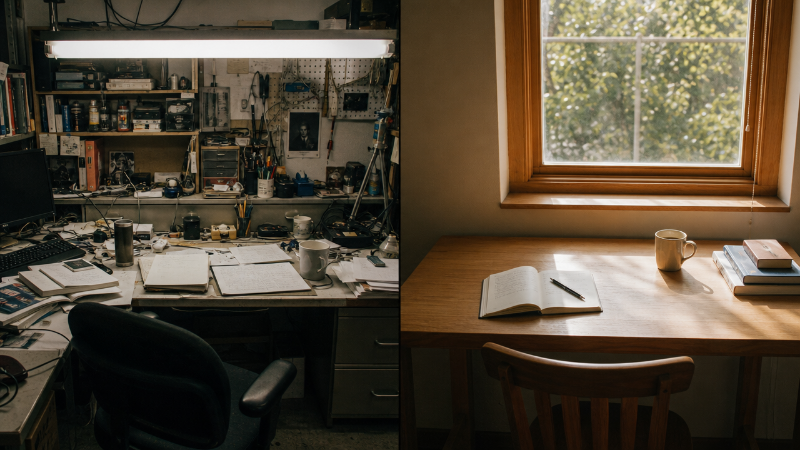
Most people attribute their output quality to effort and intention. If the work was good, they were in the right mental state. If it was poor, they didn't try hard enough.
The environment's contribution is underestimated to an extent that creates a specific kind of suffering: working hard inside a space that's actively working against the quality of output.
Your environment is not neutral. It shapes what kind of thinking is easy, what kind is difficult, and what the default mode of attention is. And it does this in ways that effort and intention can't fully override.
What Your Environment Is Actually Doing
Visual noise competes with cognitive focus. Every unresolved visual element in your field of view generates a small claim on attention. A messy desk doesn't just feel disorganized, it produces a measurable reduction in available focused attention. The attention doesn't go away; it gets distributed across all the unresolved elements instead of concentrated on the work.
Interruption patterns train attention. An environment that regularly interrupts work, notifications, open doors, surfaces visible from elsewhere in the house, trains the attention system to expect interruption. Over time, even in the absence of actual interruption, the attention stays shallower because it's learned to prepare for the pattern.
Spatial association shapes mental state. The places where you've historically done specific kinds of work become associated with those states. A desk where you've spent years doing administrative work is an environment that primes administrative thinking. The same desk used for deep creative work produces a cognitive conflict that neither type of work resolves.
Physical comfort affects decision quality. Temperature, light quality, chair ergonomics, these produce baseline states that affect the quality of decisions and the duration of sustained focus before discomfort introduces a reason to stop.
Designing for the Work You Want to Do
The goal is not a perfect environment. It's an environment that defaults toward the cognitive state required by your most important work.
Reduce the visual competition. The work surface for deep work should have only what the current task requires. Everything else, reference materials, equipment for other tasks, anything unresolved, should be out of sight or in a designated location.
Manage interruption patterns at the structural level. Don't rely on willpower to resist notifications; configure them to not arrive during protected time. Don't rely on discipline to avoid context-switching; create spatial or temporal separation between modes.
Create spatial specificity. If possible, designate specific locations for specific types of work. The location where deep work happens should not be used for email, social media, or administrative tasks. The association accumulates over time and becomes a structural asset.
Control the environmental baseline. Lighting appropriate for the type of work, temperature in a range that doesn't introduce discomfort, ergonomics that don't create a physical reason to stop. These aren't luxuries, they're the baseline conditions under which sustained work is possible.
The Return on This Investment
Environment design is a one-time investment that produces ongoing returns without ongoing willpower cost.
Most people spend energy trying to work better inside environments designed to produce worse work. The return on rearranging the environment is typically far higher than the return on applying more discipline inside an unchanged one.
Comments
No comments yet. Be the first to share your thoughts.