




Last updated:
What Most Investing Books Won't Tell You About Risk Management
Every investing book tells you risk management is important. Almost none of them show you how to do it before you place a trade. Here's the gap and how to close it.
What Most Investing Books Won't Tell You About Risk Management
Every investing book has a chapter on risk management.
Almost none of them show you how to apply it before a trade is open and your money is on the line.
That gap is not a content problem. It's a behavioral problem. And it's the reason investors who understand risk management intellectually still blow up their accounts.
The Gap Between Knowing and Doing
Most retail investors who lose large amounts of money understand, in principle, what went wrong.
They know stop-losses exist. They moved theirs anyway. They know position sizing matters. They sized by feel anyway. They know concentration is dangerous. They put 40% of the account in one name anyway.
The knowledge was there. The structure to enforce it wasn't.
That's the gap this post is about. Not more concepts to understand, a system that makes disciplined behavior the default instead of the exception.
Three Decisions That Have to Happen Before Entry
Not after. Before. When your thinking is clear and the position doesn't exist yet.
1. Define the maximum dollar loss
Not "I'll sell if it drops too much."
A number. Calculated before the trade exists.
Most systematic traders risk 1-2% of their total account per position. Take your account value, multiply by that percentage, and that dollar amount is your ceiling for this trade. Full stop. Not a guideline. A ceiling.
A 500 maximum loss.** If the position can lose more than $500, the position size is wrong. Reduce it.
2. Place the stop where the trade fails, not where you start feeling pain
Most stops are placed based on emotional math. "I'll get out if I'm down $800." That's not a stop calibrated to the trade. That's a stop calibrated to your feelings about loss.
The stop belongs at the price where the thesis is invalidated. Where the setup no longer makes sense. Not where the discomfort becomes unbearable.
The tool that gets you there is ATR, Average True Range:
Stop price = Entry price - (1.5 × 14-day ATR)
If the asset's ATR is $3.00, the stop is $4.50 below entry. That distance accounts for normal daily volatility. It's not tight enough to get stopped out by noise, and it's not wide enough to let the loss grow into something that takes months to recover from.
3. Calculate position size from the loss limit, not from the upside
This is backwards from how most investors think about it.
Most investors think: "How much do I want to make?" Then they buy enough shares to make that amount. That's not position sizing. That's wishful math.
Real position sizing starts with the loss:
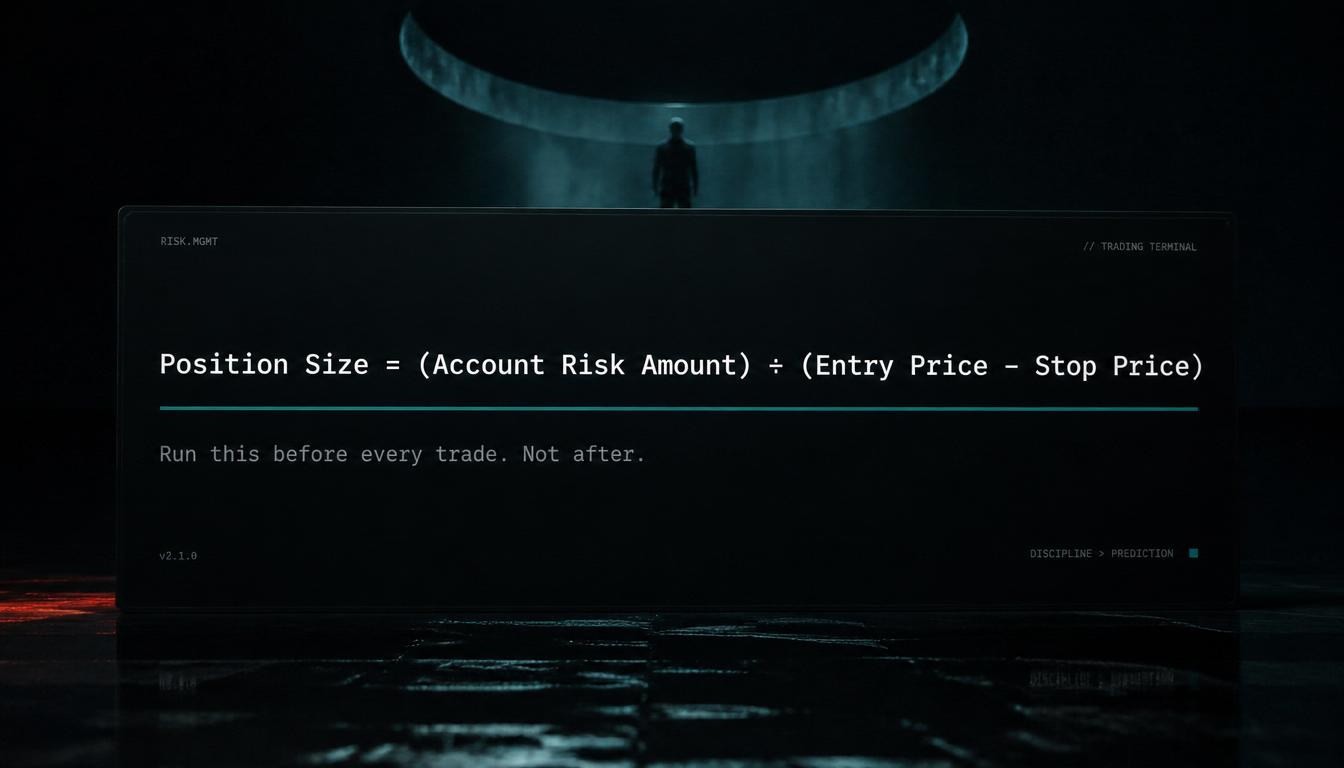
(Maximum Acceptable Loss) ÷ (Entry Price - Stop Price) = Shares to Buy
- Max loss: $500
- Entry $52.00, Stop $48.50 - distance: $3.50
- Shares: $500 ÷ $3.50 = 142 shares
Not 200 because you feel good about the setup. Not 100 because you're being cautious. 142, because that's the number that keeps this position inside the system. Every time.
Why This Matters More Than Which Stocks You Pick
The math most investors never look at until it's too late:
| Loss | Recovery Required |
|---|---|
| 25% | 33% |
| 50% | 100% |
| 75% | 300% |
A 50% drawdown requires doubling the remaining capital just to break even. If the account was generating 10% annually before the loss, that recovery takes more than seven years.
Seven years of compounding, erased by the kind of position that disciplined risk management prevents entirely.
The investor who runs the formula, places the stop, and respects the ceiling never ends up in that math. Not because they're smarter. Because the structure they built won't let them.

The Trading Plan Template, which forces all three of these decisions before any entry, is free at devinmarshall.info/playbook. The complete risk management framework, with worked examples, is in The Savvy Investor's Playbook.
Comments
No comments yet. Be the first to share your thoughts.