




Last updated:
How to Fill Out the Trading Plan Template (Step by Step)
The Trading Plan Template has ten fields. Most investors fill in three of them. This post walks through all ten — what each field is asking for, why it matters, and what a completed answer looks like.

How to Fill Out the Trading Plan Template (Step by Step)
Most investors don't finish the template.
Not because it's difficult. Because they hit a field they can't answer honestly, and instead of sitting with the discomfort, they skip it. Then they skip the next one. By the time they're done, they have a document with three fields filled in and seven blanks, which is not a trading plan. It's a worksheet with aspirations.
This post walks through all ten fields. What each one is actually asking. What makes an answer complete. And why the ones that feel hardest are the ones that matter most.
If you don't have the template yet, get it free at devinmarshall.info/playbook or by subscribing to my newsletter.
Field 1: The Ticker and Setup Type
This field isn't asking what you want to trade. It's asking why this trade exists.
There's a difference between "I want to buy Apple" and "AAPL is pulling back to the 50-day moving average on declining volume, which has been a high-probability reversal point for this asset historically." One is a wish. The other is a setup.
If you can't name the setup type; breakout, pullback to support, earnings catalyst, trend continuation; you're not ready to fill in the rest of the template. Because everything that follows is built on this.
Complete looks like: "AAPL - pullback to 50-day MA on declining volume."
Field 2: The Thesis
One sentence. That's the rule.
Not a paragraph. Not a bulleted list of reasons. One sentence that captures the single condition this trade depends on. If that condition doesn't materialize, the trade is off.
Most investors write a paragraph here because it feels more thorough. It isn't. A paragraph means multiple conditions and multiple conditions mean multiple ways to rationalize staying in when the trade has already failed.
Complete looks like: "If AAPL holds the 50-day MA and reverses on volume within 3 days, the setup is valid."
Field 3: Entry Criteria
This is the field that eliminates early entries.
Not "when it looks good." Not "when I feel confident." A specific, binary condition: price crosses above X, volume confirms Y, candle closes above Z. The entry criteria is what you're waiting for. If it doesn't happen exactly, you don't enter.
Most traders enter before the criteria are met because they're afraid of missing the move. The template forces you to define what "go" actually looks like before you're watching the chart and feeling the pull.
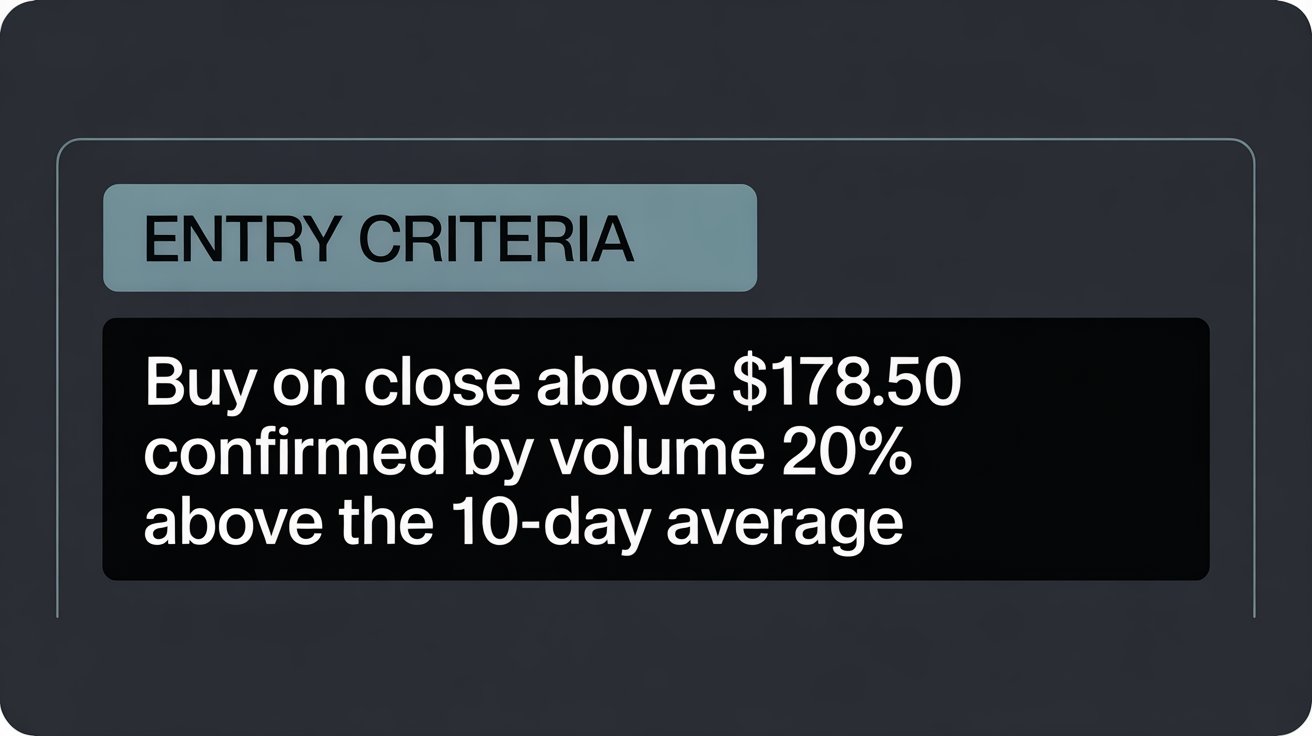
Complete looks like: "Buy on close above $178.50, confirmed by volume 20% above the 10-day average."
Field 4: Entry Price
Your planned execution price; not your hope price, your plan price.
It should match your entry criteria exactly. If your criteria says "close above $178.50," your entry is $178.50 to $179.00, accounting for slippage. If you find yourself writing a price that's meaningfully different from your entry criteria, one of the two is wrong.
Field 5: Stop-Loss Price
This is not "how much pain can I tolerate?"
That framing produces stops set by emotional math instead of trade math. The stop belongs at the price where the thesis is invalidated, not where your account balance starts feeling uncomfortable.
The most reliable calibration tool is ATR. Take the 14-day Average True Range of the asset. A stop placed 1.5x ATR below your entry keeps you outside of normal daily volatility while still defining a clear exit if the trade fails.
Complete looks like: "$175.80 - just below the 50-day MA, 1.5x ATR from entry."
Field 6: Maximum Acceptable Loss
Most investors leave this blank. It is the most important field in the document.
Work it backwards: decide the maximum percentage of your account you're willing to lose on this trade before you calculate position size. Systematic traders typically use 1-2%. Apply that percentage to your current account value.
That number is your ceiling. Not a guideline. A ceiling.
Complete looks like: "2% of $25,000 = $500 maximum loss."
Field 7: Position Size
This is the only field that requires a formula. It's also the field most investors skip in favor of instinct.
Using the example above:
- Max loss: $500
- Entry $178.50, Stop $175.80 - distance: $2.70
- Shares: $500 ÷ $2.70 = 185 shares
Not 200 because that's a round number. Not 150 because you're not "fully confident". 185, because that's the number that keeps this position inside the system. Every time.
Field 8: Price Target(s)
The target is set before you enter. Not "I'll see how it feels when it gets there."
When it gets there, greed will be setting the number. Your job is to set it now, when you're thinking clearly.
More experienced traders use two targets; selling half at the first, raising the stop to breakeven on the remainder, and letting the second target run. Build whatever structure makes sense for your strategy. Just build it before the position is open.
Complete looks like: "Target 1: $185.00 (sell 50%). Target 2: $192.00 (sell remaining)."
Field 9: Invalidation Conditions
These are the exits that don't appear in price.
The stop handles the price-based exit. This field handles everything else: a news event that changes the thesis, a sector-wide breakdown that makes the setup irrelevant, a failure to follow through within a defined time window.
Write the specific conditions. If you can't think of any, ask yourself: "What would have to happen for this trade to no longer make sense, even if price hasn't hit my stop?" Start there.
Complete looks like: "Exit if: (1) earnings announced before target, (2) no follow-through in 5 trading days, (3) market breaks the 200-day MA."
Field 10: Post-Trade Review Date
Set the date before you enter.
This is the field that turns a trade into a data point. Without it, the trade ends and disappears into memory; which, as we'll cover in another post, is a systematically unreliable record of what actually happened. With it, the trade becomes part of a body of evidence you can learn from.
Complete looks like: "Review: [entry date + 7 days]."
The Document You Now Have
Ten fields, all filled in. Every one honest.
What you have is a pre-committed record of what you expected, what you decided, and what rules you agreed to follow; set when your thinking was clearest, not when the market was moving and your emotions were loud.
That's the system. That's what the template is for.

Get the free Trading Plan Template at devinmarshall.info/playbook. The full template set, including the Trade Journal, is in The Savvy Investor's Playbook.
Comments
No comments yet. Be the first to share your thoughts.