




Case Study
Building Project Lifescape
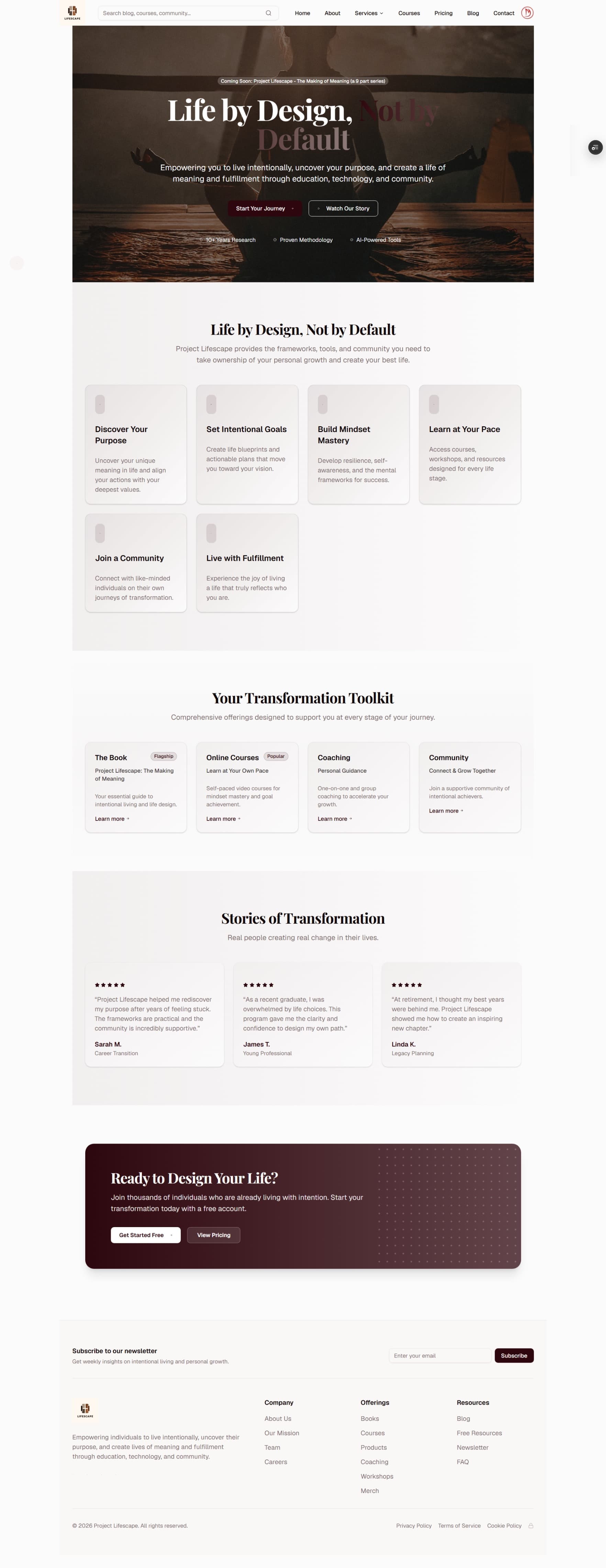
Creator and community platform stacks are fragmented by design, most operators stitch together four to six separate tools to cover courses, community, events, bookings, email, and analytics. I designed and built Project Lifescape from scratch as a unified alternative: a single full-stack platform covering the full member lifecycle from onboarding through ongoing engagement. The result is a production-ready SaaS system with 164 pages, 51 API routes, a 90-page admin suite, a full CRM, 13-role RBAC, live video, livestreaming, e-commerce, gamification, and realtime features; built and shipped by one developer.
Background & Context
The creator economy is dominated by closed, expensive platforms (Kajabi, Circle, Mighty Networks) or fragmented open-source tools that require significant self-hosting and integration work. Operators choosing the former trade control for convenience; those choosing the latter trade speed for customization. Neither serves a creator who needs real operational tooling — CRM, financial reporting, drip campaigns, marketing analytics — alongside the member-facing product.
Project Lifescape was built to close that gap: a platform that owns the full stack, from the public marketing site and membership tiers through to the executive dashboard and revenue forecasting.
Problem Statement
The Question: How do you build a platform that serves both the member experience (learning, community, live events) and the operator experience (CRM, financials, content management, marketing) without creating a fragmented, unmaintainable codebase; as a solo developer?
The Problem: No affordable platform combines course delivery, threaded community, live interactive video, direct messaging, gamification, digital and physical e-commerce, and a multi-role admin suite in a single, cohesive product. Operators who want this stack pay for five separate subscriptions and live with five separate data silos.
The Challenge: Building this solo meant every architectural decision had to scale; the data model, the access control layer, the component architecture, and the integration strategy all needed to be right before the first page was built. Over-engineering any layer would slow velocity; under-engineering would create expensive rewrites later.
Methodology / Approach
Component architecture: Next.js App Router with a strict server/client split. Server components handle all data fetching and pass props to narrow *-client.tsx components for interactive state. This keeps JavaScript payloads small and rendering fast by default.
Data layer: Supabase as the single source of truth; PostgreSQL for relational integrity, Row Level Security for multi-tenant data isolation, Realtime for live features (event chat, notifications, feed updates), and Storage for media. All mutations route through server actions in src/lib/actions/ with input validation and permission checks before any database call.
Design system: Tailwind CSS v4 + shadcn/ui (Radix UI v1.4.3) with a dark-mode-first OKLCH color palette. Using a pre-built component library meant UI consistency without building from scratch, while Tailwind's utility classes kept the design responsive across mobile, tablet, and desktop.
Access control: 13-role RBAC designed before the first admin page was built. A user_role[] enum on profiles, a page-role mapping in admin-role-config.ts, and middleware enforcement in supabase/middleware.ts meant adding new pages to the admin never required revisiting the access model.
Integration strategy: Each third-party API wrapped in a thin helper module (src/lib/stripe.ts, src/lib/daily.ts, src/lib/mux.ts, src/lib/printful/) so the rest of the codebase stays decoupled from any single vendor's SDK.
Analysis and Findings
Five constraints shaped the design before a line of code was written:
Member onboarding is make-or-break. A platform with 30+ features is a churn risk on first login. The solution was an onboarding wizard that gates the dashboard until users complete their profile and state their goals, ensuring the first session feels purposeful rather than overwhelming.
Community engagement requires low friction. Requiring markdown knowledge or a text-only box suppresses posting. A Tiptap rich text editor for threads and replies, paired with an infinite-scroll feed, keeps the community loop fast.
Live events have two distinct modalities. One-on-one coaching calls (Daily.co rooms, fully interactive) and group broadcasts (Mux livestreaming with live chat) are architecturally different and require separate implementations. Conflating them into one component would have created brittle abstractions.
Admin operators need a real CRM. A list of users with a notes field is not a CRM. Operators managing a creator business need pipeline stages, deal tracking, health scores, drip campaign assignments, activity logs, and territory management; the same features a sales team would expect from Salesforce, sized for a creator-scale operation.
Gamification must be structural, not cosmetic. Badges and streaks only drive engagement if they're tied to real actions, completing lessons, posting in the community, attending events. The user_statistics table and achievement_badges system were designed to read from actual event records, not separate counters that could drift.
Solutions and Implementation
Member-Facing Platform (33 dashboard pages)
A personalized dashboard surfaces the member's progress, upcoming events, community activity, and quick actions. The course player handles modules, lessons, quizzes, and certification issuance. Community threads support infinite scroll, rich text replies, and avatar-linked author profiles. Direct and group messaging uses Supabase Realtime for instant delivery. The live events page covers registration, Mux broadcast viewing, and real-time chat. Video call bookings integrate with Cal.com for scheduling and Daily.co for the call itself. A 50+ badge achievement system, streaks, engagement scoring, and a leaderboard drive ongoing participation. A merch store backed by Printful handles print-on-demand fulfillment. An affiliate dashboard tracks referrals and commissions.
Conclusion and Lessons Learned
Project Lifescape shows that a solo developer can ship a production-grade SaaS platform covering the full creator economy stack if the architecture is decided before the first feature is built. The biggest leverage points were the server/client component discipline (data fetching stays on the server; client components stay narrow), the upfront RBAC design (retrofitting access control onto 90 pages would have been expensive), and the Supabase Realtime integration (live features at zero infrastructure cost).
The most important lesson is also the most unsexy: schema design and access control are product decisions, not implementation details. The shape of the user_role enum and the RLS policies on every table determined what features were even possible, getting those right early created a foundation the rest of the platform could build on without revisiting.
Project README
Project Lifescape
A comprehensive community and learning platform built with modern web technologies. Lifescape enables users to connect, learn, share, and grow together through courses, live events, messaging, video calls, and community engagement.
Tech Stack
- Framework: Next.js 16.2.3 (App Router, Turbopack, TypeScript 5)
- Runtime: React 19.2.3
- Database & Auth: Supabase (PostgreSQL, Auth, Realtime, Storage) —
@supabase/supabase-jsv2.97,@supabase/ssrv0.8 - Styling: Tailwind CSS v4 + shadcn/ui (Radix UI v1.4.3) + Geist font
- Payments: Stripe v20 (API version
2026-02-25.clover) + React Stripe.js v5 - Video: Daily.co v0.89 (interactive video calls), Mux v12 (livestreaming)
- Animations: Framer Motion v12 + Lottie React
- Notifications: Sonner v2 (toast notifications)
- Email: Resend + SendGrid (inbound webhooks)
- Rich Text: Tiptap v3 editor + React Markdown v10
- Charts: Recharts v3
- Forms: React Hook Form v7 + Zod v4
- State: Zustand v5 + TanStack Query v5
- PDF: PDFKit v0.17
- Merch: Printful (print-on-demand, via custom API client)
- AI: OpenAI API
Key Features
User Features
- Authentication & Profiles — Supabase Auth with profile customization, avatars, bios
- Dashboard — Personalized dashboard with stats, progress tracking, quick actions
- Courses & Learning — Enroll in courses, complete lessons, take quizzes, earn certifications
- Community — Create/join discussion threads, reply, build social connections
- Messaging — Direct 1-on-1 and group messaging with Realtime updates
- Live Events — Register for events, watch interactive video (Mux livestreaming), live chat
- Video Calls — Schedule bookings with video calls via Daily.co (1-on-1 meetings)
- Content Library — Save/bookmark blog posts, courses, and resources
- Gamification — 50+ achievement badges, streaks, engagement scoring, leaderboards
- Merch & Shop — Browse and order merchandise (Printful print-on-demand)
- Affiliate Program — Track referrals, earn commissions, access marketing assets
- Subscription Tiers — 5 tiers: Free → Explorer → Pathfinder → Architect → Visionary
- Contests — Enter and submit to creative contests
- Notifications — Real-time notifications with Supabase Realtime
- Global Search — Cmd+K search palette across all content
Admin Features
- 13-Role Access Control — Hierarchical RBAC: superadmin, ceo, coo, cfo, cto, content_director, marketing_director, sales_director, community_manager, support_agent, advisory_board, data_manager, admin — with temp-admin and data-team membership overrides
- 90+ Admin Pages — Dashboard, executive summary, operations, revenue, financials (reports/earnings/payouts/contractors), budget management, tax & compliance, investor dashboard
- Full CRM Suite — Contacts, accounts, pipeline, activities, forecasting, lead scoring, playbooks, RevOps, territories, workflows, reports
- Content Management — Blog editor, course builder (modules/lessons), product management, resource library, media gallery, email templates
- Marketing Tools — Campaign manager, newsletter builder, editorial calendar, search analytics, social tracker, A/B testing, landing pages
- Community & Events — Community management, moderation, events, bookings, contests, polls, badges, member segments
- Finance & Commerce — Revenue dashboard, invoices, refunds, coupons, pricing management, affiliate program, merch orders (Printful)
- System & Data — User management, audit log, platform health, data management (tables/reports/team-reports), webhooks, integrations
- Analytics — SQL analytics console, learning analytics, community health, abandoned cart tracking
Getting Started
Prerequisites
- Node.js 18+ (recommend using the latest LTS)
- npm, yarn, pnpm, or bun
- Supabase account
- Stripe account (for payments)
- Daily.co account (for video)
- Mux account (for livestreaming)
- Resend account (for email)
Installation
Clone the repository:
git clone https://github.com/TheOfficialDM/lifescape.x.git
cd lifescape.x
Install dependencies:
npm install
# or yarn install, pnpm install, bun install
Set up environment variables:
cp .env.example .env.localFill in the
.env.localfile with:# Supabase NEXT_PUBLIC_SUPABASE_URL=your_supabase_url NEXT_PUBLIC_SUPABASE_ANON_KEY=your_anon_key SUPABASE_SERVICE_ROLE_KEY=your_service_role_key # Stripe STRIPE_SECRET_KEY=your_stripe_secret NEXT_PUBLIC_STRIPE_PUBLISHABLE_KEY=your_stripe_public_key STRIPE_WEBHOOK_SECRET=your_webhook_secret STRIPE_CONNECT_WEBHOOK_SECRET=your_connect_webhook_secret # App NEXT_PUBLIC_APP_URL=http://localhost:3000 CRON_SECRET=your_random_secret_for_cron # Email RESEND_API_KEY=your_resend_api_key SENDGRID_API_KEY=your_sendgrid_api_key EMAIL_FROM=noreply@yourdomain.com # Video & Livestreaming DAILY_API_KEY=your_daily_api_key NEXT_PUBLIC_DAILY_DOMAIN=your_daily_domain MUX_TOKEN_ID=your_mux_token_id MUX_TOKEN_SECRET=your_mux_token_secret # Printful (merch) PRINTFUL_API_KEY=your_printful_api_key # AI OPENAI_API_KEY=your_openai_api_keyPush database migrations:
supabase db pushOr manually run migrations via the Supabase dashboard.
Start the development server:
npm run devOpen http://localhost:3000 to see the app.
Project Structure
src/
├── app/                              # Next.js App Router (164 pages, 51 API routes)
│   ├── (admin)/admin/               # Admin dashboard (90+ pages, role-gated)
│   │   ├── crm/                     # Full CRM: contacts, accounts, pipeline, forecasting, etc.
│   │   ├── financials/              # Financial reports, earnings, payouts, contractors
│   │   ├── courses/                 # Course CRUD, analytics, student management
│   │   ├── data/                    # Data management hub, tables, reports, team access
│   │   ├── email-templates/         # Email template editor with brand settings
│   │   ├── users/                   # User management, temp access grants
│   │   ├── events/                  # Event management
│   │   └── ...                      # 70+ more admin pages
│   ├── (user)/dashboard/            # User dashboard (33 pages)
│   │   ├── courses/                 # Course player, quizzes
│   │   ├── messages/                # Direct messaging
│   │   ├── community/               # Discussion threads
│   │   ├── events/                  # Live events
│   │   ├── bookings/                # Video call bookings
│   │   ├── orders/                  # Digital + merch orders
│   │   └── ...                      # Profile, settings, billing, etc.
│   ├── (marketing)/                  # Public pages (32 pages)
│   │   ├── services/               # Service pages (coaching, books, web3, etc.)
│   │   ├── blog/, courses/, events/ # Content listings + detail views
│   │   ├── merch/                   # Merchandise store
│   │   └── ...                      # Pricing, FAQ, legal pages, etc.
│   ├── (auth)/                       # Auth: login, signup
│   ├── api/                          # API routes (51 endpoints)
│   │   ├── webhooks/               # Stripe, SendGrid, Printful, Cal.com
│   │   ├── cron/                    # 6 cron endpoints (daily, SLA, sequences, etc.)
│   │   ├── admin/                   # Admin API (SQL, uploads, newsletters, licenses)
│   │   ├── payment-methods/         # Payment method CRUD
│   │   ├── licenses/                # License validation, activation, checkout
│   │   └── ...                      # Search, session, revalidate, etc.
│   └── error.tsx, not-found.tsx      # Error boundaries
├── components/                       # 32 component directories
│   ├── ui/                           # shadcn/ui primitives (50+ components)
│   ├── layout/                       # Header, sidebar, footer, navigation
│   ├── admin/                        # Admin-specific components
│   ├── video/                        # Daily.co + Mux components
│   ├── events/                       # Event registration, live chat
│   ├── courses/                      # Course player, lesson cards
│   ├── community/                    # Thread lists, reply forms
│   ├── messages/                     # Conversation UI
│   ├── feed/, realtime/              # Activity feed, realtime notifications
│   ├── search/                       # Global search palette
│   ├── save/, share/                 # Bookmark + social share
│   ├── marketing/                    # Marketing page components
│   ├── badges/                       # Achievement badge system (50+ badges)
│   ├── animations/                   # Framer Motion + Lottie
│   └── ...                           # Checkout, invoices, blog, etc.
├── lib/                              # 37 library files
│   ├── actions/                      # Server actions (7 modules)
│   ├── supabase/                     # Supabase clients (server, client, admin, middleware)
│   ├── printful/                     # Custom Printful SDK
│   ├── admin-role-config.ts          # RBAC: 13 roles, page-role map, nav config
│   ├── badges.ts                     # 50+ achievement badges
│   ├── constants.ts                  # App constants, tier configs
│   ├── stripe-connect.ts             # Stripe Connect (payouts)
│   ├── subscription-renewal.ts       # Renewal orchestration
│   ├── invoice-generator.ts          # PDFKit invoice generation
│   └── utils.ts, daily.ts, mux.ts   # Utility + API helpers
├── types/                            # 7 TypeScript definition files
└── styles/
    └── globals.css                   # Tailwind v4 + OKLCH palette + dark mode
Database Schema (Key Tables)
Core
| Table | Purpose |
|---|---|
profiles |
User profiles, roles (user_role[]), engagement scores, onboarding flag |
subscriptions |
Membership tiers (free → visionary), billing info |
Courses & Learning
| Table | Purpose |
|---|---|
courses, course_modules, course_lessons |
Course content & structure |
course_enrollments, lesson_completions |
User progress tracking |
quizzes, quiz_questions, quiz_attempts |
Course quizzes |
Community & Social
| Table | Purpose |
|---|---|
community_threads, user_posts, community_replies |
Community discussions |
events, event_registrations, event_chat_messages |
Events & registrations (Realtime) |
bookings |
Video call bookings with meeting URLs |
user_messages, message_recipients |
Direct messaging |
Gamification
| Table | Purpose |
|---|---|
achievement_badges, user_streaks |
Badges (50+ defined) & streaks |
user_statistics |
Aggregated user stats |
CRM & Sales
| Table | Purpose |
|---|---|
crm_contacts, crm_accounts |
CRM contacts & accounts |
crm_deals, crm_pipeline_stages |
Sales pipeline |
crm_activities, crm_notes |
Activity tracking & notes |
crm_health_scores, crm_customer_tags |
Health scoring & tagging |
crm_drip_assignments, crm_drip_campaigns |
Drip campaign automation |
Commerce & Finance
| Table | Purpose |
|---|---|
orders, order_items |
Digital product orders |
merch_orders |
Merchandise orders (Printful) |
invoices |
Generated invoices |
coupons, coupon_redemptions |
Coupon codes |
licenses, license_activations |
Software licenses |
affiliate_clicks, affiliate_commissions |
Affiliate tracking |
Content & Admin
| Table | Purpose |
|---|---|
blog_posts |
Blog content |
products |
Digital products |
saved_content |
Bookmarked content (with RLS) |
data_team_members |
Data team access control (time-gated) |
search_keywords |
Search analytics data |
newsletters, newsletter_segments |
Email newsletters |
Custom Enums
| Enum | Values |
|---|---|
user_role |
20 values: user, moderator, coach, instructor, support, editor, partner, admin, temp_admin, superadmin, ceo, coo, cfo, cto, content_director, marketing_director, sales_director, community_manager, support_agent, advisory_board, data_manager |
membership_tier |
free, explorer, pathfinder, architect, visionary |
order_status |
pending, processing, completed, cancelled, refunded |
course_status |
draft, published, archived |
product_status |
draft, active, archived |
Development Workflow
Running Locally
npm run dev
Building for Production
npm run build
npm start
Type Checking
npx tsc --noEmit
Database Migrations
Create a new migration in supabase/migrations/:
supabase migration new migration_name
Then push to your Supabase project:
supabase db push
Server Actions
Place all mutations in src/lib/actions/ with the "use server" directive. Always validate input and check user permissions.
Authentication
- Server: Import
createClient()from@/lib/supabase/server - Client: Import
createClient()from@/lib/supabase/client - Admin: Import
createAdminClient()from@/lib/supabase/admin(service-role queries only)
Code Conventions
Naming
- Components: PascalCase (e.g.,
FeedbackModal,CommentList) - Files: kebab-case for components (e.g.,
feedback-modal.tsx) - Folders: kebab-case or PascalCase as appropriate
- No duplicate or ambiguous names
Component Organization
- UI primitives:
components/ui/ - Layout components:
components/layout/ - Feature-specific:
components/[feature]/ - File pattern: Server page → props to
*-client.tsxfor interactive state
Imports
- Use alias imports:
@/lib,@/components,@/types - Radix UI imports:
import { Dialog as DialogPrimitive } from "radix-ui"(not@radix-ui/react-dialog)
Error & Empty States
- 404 errors:
app/not-found.tsx(branded design) - 500 errors:
app/error.tsx(friendly message with retry) - Empty states: Use
EmptyStatecomponent fromcomponents/ui/empty-state.tsx
Styling
- Use Tailwind CSS with shadcn/ui components
- Dynamic widths: Use inline
style={{ width: \${pct}%` }}(NOT Tailwind dynamic classes likew-[X%]`) - Dark mode: Implemented via
next-themeswith.darkoverrides inglobals.css
Deployment
Vercel (Recommended)
- Push to GitHub
- Connect repo to Vercel
- Set environment variables in Vercel dashboard
- Deploy (automatic on main branch pushes)
Environment Variables for Production
Ensure all required env vars are set in Vercel before deploying (see Installation section).
Contributing
This project uses:
- TypeScript — Type safety required
- Tailwind CSS + shadcn/ui — Consistent component library
- Server actions — Mutations in
src/lib/actions/ - Supabase — All data queries and auth
Before Submitting a PR
- File structure: Follow naming conventions above
- Types: Add TypeScript types (
src/types/) - Error handling: Validate user input and check permissions
- Dark mode: Test light and dark themes
- Mobile: Test on mobile devices (fixed bottom tab bar)
- Accessibility: Use semantic HTML and ARIA attributes where needed
Testing
Unit and integration tests should be added for critical features. Configuration to be added soon.
Support
For questions or issues:
- Check existing GitHub issues
- Create a new issue with a clear description
- Include environment details and reproduction steps
License
All rights reserved. © Devin Marshall
Project Gallery
This album hosts the website screen captures for Project Lifescape.